Sage Path Press
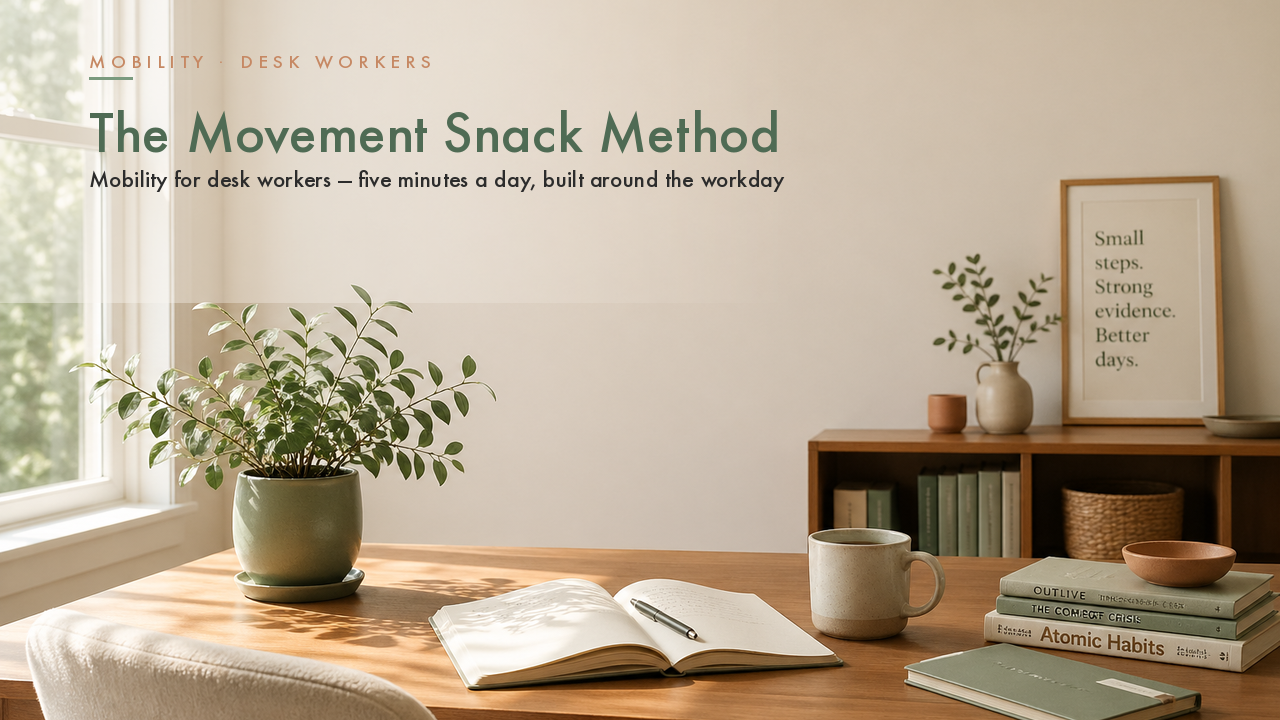
The Movement Snack Method — Mobility for Desk Workers
The Movement Snack Method — Mobility for Desk Workers
Couldn't load pickup availability
For the knowledge worker whose body has quietly absorbed the cost of the desk.
You have probably tried a mobility program before. Maybe a $95 video library you opened twice, or a 30-day stretching plan that lived in your downloads folder until you sheepishly deleted it. You did not fail because you were lazy, and you did not fail because your body is uniquely broken. You failed because every program assumed you had an hour you do not have, on a mat you do not roll out, in a moment of the day that does not exist.
The Movement Snack Method is built the other way around. It assumes the workday wins. It assumes you have ninety seconds between meetings, not ninety minutes after dinner. And it assumes you are intelligent, time-poor, and skeptical of anyone selling you "perfect posture" or "sitting is the new smoking" panic — both of which are oversold and, in places, wrong.
What you get — a 32-page, professionally typeset PDF guide built around a five-phase method:
- Decode — what sitting actually does to hip flexors, the thoracic spine, the neck, and the median nerve, plus a Beighton-style hypermobility self-screen that routes you to the right track and a non-skippable red-flag triage for the small minority of cases that need a clinician, not a stretch.
- Anchor — four short flows you will memorize like your phone number. Hip, spine, yoke (shoulders/upper back/neck), and wrist-and-breath. Each takes 60–120 seconds. Each can be done in business clothes, in a small office, without a mat, without an audience. Every flow includes a stability-track variant for hypermobile readers.
- Stack — how to bind each flow to a moment that already exists in your day (coffee, standup, lunch return, end-of-day shutdown), the bookend protocol for long meetings, the 90/120 rule for sit duration, and an honest take on the standing-desk truth.
- Progress — an eight-week arc that adds load before it adds range, then variability, then asks you to design your own snack stack from a 24-movement menu. Specific session prescriptions with novice setup detail; not "do more" — earned range.
- Sustain — the maintenance dose, permission for travel/sick/deload weeks, modifications for pregnancy, post-surgery, perimenopause, and hypermobility, and an opinionated guide to when to bring in a PT versus a movement coach versus a chiropractor.
What makes it different. The $20–$80 middle of the market is empty. Cheap Etsy printables show you decorative seated stretches with no progression. Premium $95+ programs assume 30–45 minutes on a floor mat. This guide is the missing middle: a structured 4–8 week program of 60–120-second desk-side micro-doses, progressively layered, grounded in plain-language anatomy of what eight hours of sitting actually does to the hip capsule, thoracic spine, and shoulder girdle.
Evidence-grounded, not evidence-flavored. Nineteen peer-reviewed and primary sources cited inline — Patterson 2018 on dose-response sitting risk, the Ekelund 2016 Lancet harmonized analysis of more than a million adults, Lederman 2011 and Swain 2020 on the weak posture-pain link, Albulescu 2022 on active microbreaks, Duran 2023 on breaking up sitting, McGill on tissue migration, Spina's FRC framing on usable range, OSHA and NIOSH ergonomics, the Ehlers-Danlos Society on hypermobility programming, and the WHO 2020 physical activity guidelines.
What this is not. Not a yoga teacher training. Not a posture-correction product. Not a fear-of-the-chair manifesto. Not a video library. Not a substitute for medical care when red-flag symptoms are present. Sage Path Press makes no overclaim that mobility work cures pain, fixes alignment, or eliminates the need for clinical assessment when one is genuinely needed.
Format. Instant digital download. PDF, 32 pages, US Letter, professionally typeset in Sage Path Press's house style with three custom anatomical diagrams (hypermobility decision tree, anchor-flow schematic, eight-week progression map) and chapter heroes throughout.
This guide is for general information and educational purposes only. It is not medical advice. Consult a qualified healthcare provider before beginning any new exercise program — particularly if any red-flag symptoms described in Section 1.5 are present.
Materials
Materials
Shipping & Returns
Shipping & Returns
Dimensions
Dimensions
Care Instructions
Care Instructions
Share